

The Bizarre & Beyond: The Spider-Tailed Viper, Toy-Making Raccoons, and the Mysterious Holes on Mars
Posted by Elizabeth Vasquez on

We all love a good surprise.
A gift with an unexpected detail. A strange fact that sticks in your mind. A tiny discovery that makes an ordinary Saturday feel much more interesting.
That is the theme of The Bizarre & Beyond : Edition 7.
This week, we are looking at three extraordinary stories: a snake with a fake spider on its tail, endangered raccoons that make their own toys, and mysterious holes on Mars that scientists cannot yet explain.
September is all about curiosity, after all. New notebooks. New questions. New reasons to wonder why the universe refuses to behave normally.
Let’s investigate.
1. The Snake That Brings a Spider to Dinner

The spider-tailed horned viper (Pseudocerastes urarachnoides) has one of nature’s most astonishing disguises.
The tip of its tail looks remarkably like a spider. It has a bulbous body and long, dangling leg-like structures. When a bird spots the apparent spider and swoops in for a meal, the viper strikes.
The bird is the meal instead.
Talk about turning the tables.
A museum mystery decades in the making
The species is native to Iran, but scientists did not immediately understand what they were looking at.
A specimen was collected in 1968 and placed in the Field Museum in Chicago. For decades, staff thought the strange tail tip might be a tumor or deformity. Then, in 2003, another snake with the same unusual feature was found.
The mystery deepened.
In 2006, researchers described the animal as a new species. Its scientific name, Pseudocerastes urarachnoides, translates roughly to the spider-tailed horned viper.
Recently, researchers used XCT scanning to look inside the museum’s original specimen, known as the holotype. The scans revealed something surprising: the bones inside the tail are remarkably ordinary.
The spider shape is created by the snake’s external soft-tissue morphology, including dramatically modified scales. In other words, the viper’s skeleton does not give away the secret. The deception happens on the outside.
That matters far beyond one incredible snake.
Paleontologists often work with fossilized bones and teeth. But the viper shows how much information can disappear when only the skeleton remains. An ancient animal may have had elaborate skin, scales, feathers, colors, or behaviors that fossil bones could never fully reveal.
As study co-author Sara Ruane of the Field Museum explained, museum specimens can continue teaching us new things long after they were collected. Sometimes the strangest answer has been sitting quietly on a shelf the entire time.
The Beyond Unusual find
The viper’s trick has a natural connection to B.U.G.S. : Beyond Unusual Gift Shop’s celestial beetle identity.
For an insect-inspired accent with a cosmic twist, explore the Celestial Collection. You will find unusual pieces designed to make people pause, look closer, and ask questions.
A celestial beetle ornament or scarab-inspired gift-box motif brings that same sense of transformation into your space. It is decorative. It is mysterious. It is definitely more memorable than another perfectly sensible little bowl.
That is the Von Restorff Effect in action: when one item stands apart from everything around it, the brain is more likely to notice and remember it.
A fake spider on a snake’s tail? Impossible to forget.
2. The Raccoons That Turned Trash Into Toys

The next story is smaller in scale but just as extraordinary.
On Cozumel Island in Mexico, researchers observed a young Cozumel pygmy raccoon (Procyon pygmaeus) making a toy from discarded paper.
The critically endangered species has fewer than 200 mature individuals remaining. So this was not simply a cute animal video. It was a rare glimpse into the intelligence, play, and social learning of a fragile island species.
Here is what happened.
The young raccoon climbed into a beach-club trash bin. She ignored the food scraps, pulled out a piece of paper, soaked it in a water bowl, and rolled it through sand until it formed a ball.
Then she played with it.
She batted the ball. Chased it. Treated it like a tiny homemade toy.
Her sister watched closely and began trying to make one, too.
Learning by watching
Over 64 hours of observation, researchers documented 14 ball-making sequences. Eight resulted in completed balls.
The second juvenile failed during her first four attempts. Then, after her sister was removed for rehabilitative care, she successfully made a ball on her own. She had watched, practiced, and eventually figured out the sequence.
Water first. Then rolling. Then sand. Then play.
Researchers described this as evidence of social learning. It may also be the first documented case of raccoons deliberately transforming material for a purpose unrelated to food.
That is a remarkable leap. The paper was not eaten. It was not used as shelter. It became something new.
A toy.
The story also carries a sad reminder. Juvenile 1 later died while in rehabilitative care, highlighting how vulnerable this rare species remains. The discovery is joyful, but conservation is still urgent.
The Beyond Unusual find
This story is a perfect match for playful home offices, cozy study corners, and creative desks.
The Creative LED Library Lantern Bookshelf Lamp can make a shelf glow like a miniature reading nook. The “Reading” Desktop Gift Figurine adds a small, thoughtful detail to an office, dorm room, study area, or classroom-inspired corner.
The idea is simple: take an ordinary space and give it a story.
The raccoons turned discarded paper into something delightful. You can turn a shelf into a cozy little library. A desk into a creative headquarters. A reading corner into a place that feels entirely your own.
The Von Restorff Effect applies here, too. One unusual object can become the detail everyone remembers.
And unlike the raccoons, you do not have to retrieve it from a trash bin.
3. The Holes on Mars That Nobody Can Explain
Mars has never been short on mysteries.
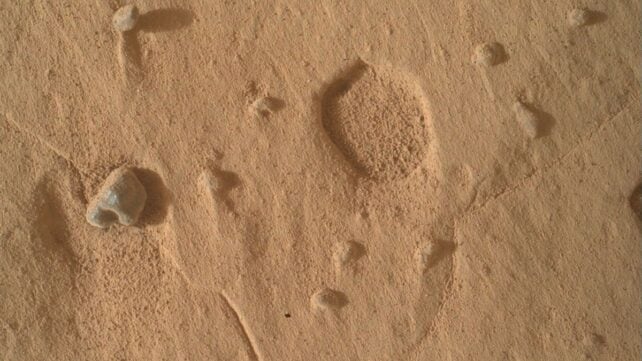
But after nearly 14 years exploring Gale Crater, NASA’s Curiosity rover has found something new to puzzle over: strange, broad, shallow divots scattered across the ground in Valle Grande, a valley on Mount Sharp.
The holes are small. Some measure roughly one centimeter across.
Their origin, however, is a much larger question.
Usually, small pits in Martian bedrock have a straightforward explanation. Pebbles or mineral nodules embedded in softer rock can resist erosion. Eventually, they weather out and leave cavities behind.
These new divots appear different.
They are unusually broad and shallow. There are no obvious pebbles or mineral nodules nearby that explain what used to be there.
So the science team is taking a closer look.
A detective story written in stone
Curiosity’s MAHLI close-up camera is photographing the divots in detail. Its Mastcam system is capturing overlapping stereo images.
Together, the images can create three-dimensional models of the terrain. Scientists can then measure the shapes and depths of the holes and work backward toward a possible explanation.
The leading ideas include an unfamiliar erosion process, an unusual property of the sulfate-rich rock, or something else entirely.
That last option is doing a lot of work in planetary science.
The mystery is especially interesting because Curiosity is climbing through layers that preserve clues about ancient Mars. In late August, the rover reached a milestone of 1,000 meters in elevation gain while ascending Mount Sharp.
The higher Curiosity climbs, the more geological history it encounters.
Layer by layer. Image by image. Question by question.
Mars is not handing over its secrets quickly. It is making scientists earn them.
The Beyond Unusual find
For earthbound explorers, the Celestial Collection offers plenty of ways to bring a little cosmic mystery home.
Try moon-phase pillar candles for a warm, atmospheric glow. Add a Galaxy Crystal Ball to a bookshelf or desk. Or browse the collection for celestial accents that make a room feel less like a room and more like a personal observatory.
These pieces are perfect for a cozy-season reset, especially if your study space could use something more inspiring than a stack of unopened folders.
A little mystery helps.
Keep Looking Beyond the Ordinary
The spider-tailed viper reminds us that appearances can deceive.
The pygmy raccoons show us that creativity can emerge in unexpected places.
Mars reminds us that even after years of exploration, there are still questions waiting in plain sight.
That is the art of being different. Not simply choosing something unusual for the sake of standing out, but noticing the details that make life more interesting.
A strange tail. A handmade toy. A shallow hole in an ancient landscape.
These are the things that stay with us.
Keep asking questions. Keep following the curious trail. Keep filling your home, your desk, and your gift list with pieces that feel personal, surprising, and beyond the ordinary.
For more unusual discoveries, memorable gifts, and cosmic curiosities, visit Beyond Unusual Gift Shop or join our newsletter.
By popular demand, we're extending the discount... Use WELCOME10 for 10% off your first order, or WELCOMEBACK10 for 10% off when you shop with us again.
Sources & Further Reading
- The Field Museum: A fake spider at the tip of this snake’s tail helps it lure birds
- New Scientist: Pygmy raccoons teach each other to make toys out of paper and sand
- ScienceAlert: NASA found strange holes on Mars
- NASA: Curiosity reaches a 1-kilometer elevation gain
Eli
Share this post
- 0 comment
- Tags: b-u-g-s, celestial-decor, cozy-season, curiosity-rover, mars-mystery, pygmy-raccoon, quirky-home-accessories, spider-tailed-viper, the-bizarre-and-beyond, unusual-gifts